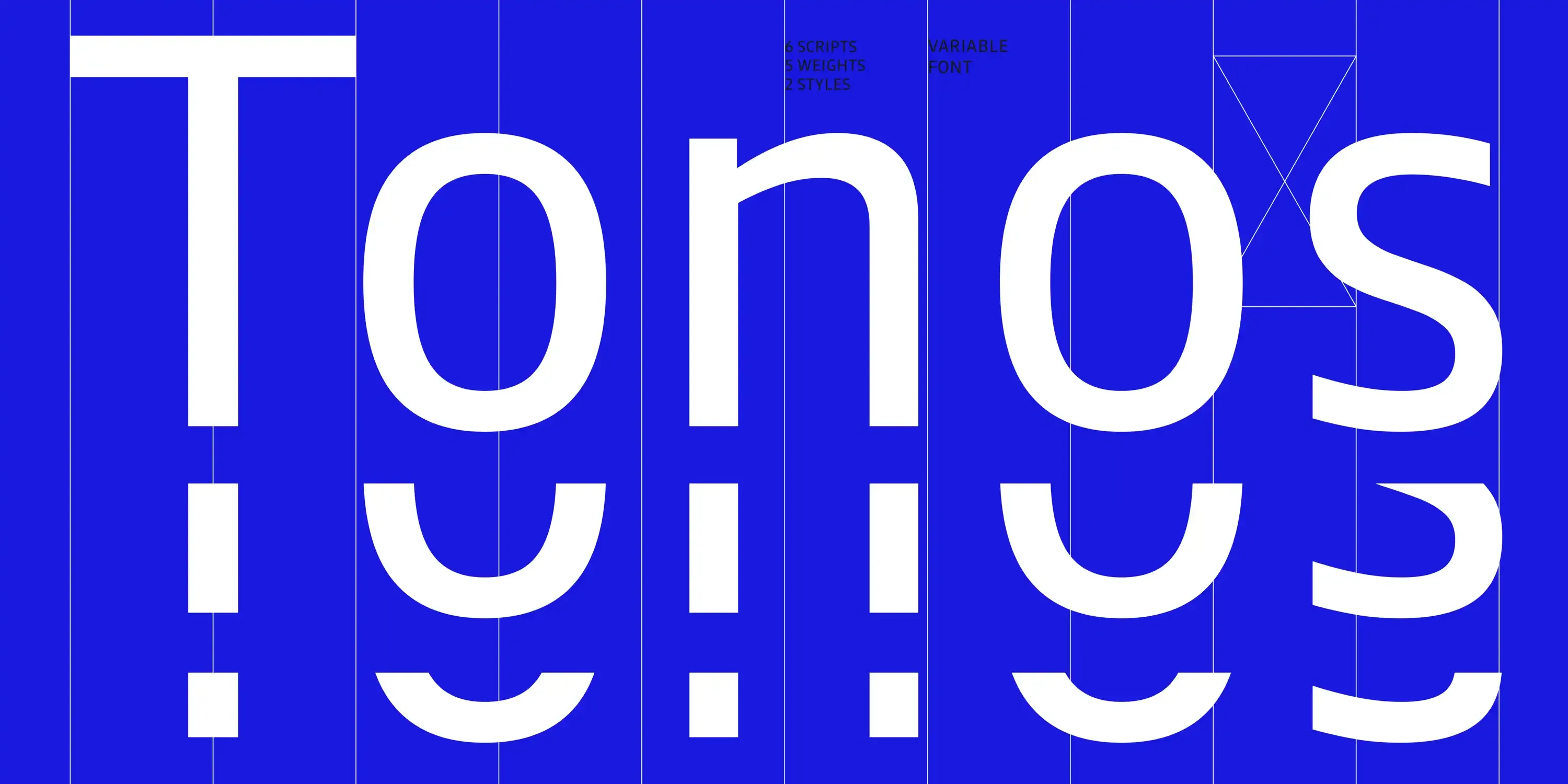
Tonos is a sans serif font family designed for UI and HMI contexts, supporting Arabic, Cyrillic, Greek, Hebrew, Latin, and Thai. Its calligraphic heritage gives it a warm, humanistic quality carried across all scripts for harmony and legibility. Available in weights from Light to Bold with matching italics, two widths, and monospaced styles, Tonos also comes as a variable font with weight and width axes, offering versatility for functional yet engaging interface typography.
?2e9a)
?a648)
?f2cd)
?a02d)
?dffa)
?cfd7)
?378c)
?9aeb)
?ab09)
?1a4f)
?00cb)
?8017)
?e657)
?684f)
?480e)
?ab13)
Type design is wonderful!
The art of cross-cultural type design is a fascinating field that explores the intersection of typography and multilingualism. It involves designing typefaces that can be used across different languages and writing systems, while still maintaining their aesthetic and functional qualities. This requires a deep understanding of the unique features of each writing system, as well as the cultural context in which they are used. Cross-cultural type design is essential in today's globalized world, as it allows people from different linguistic and cultural backgrounds to communicate effectively.
We notice type most when it's wrong. When something feels off. The spacing's tight, the voice is too loud, or it just doesn't match what's being said. But when the type is right, it gets out of the way — and helps the words do their job. It can give structure to ideas. It makes space for meaning. Typography isn't just about style. It's about the way we take in information. It adds rhythm to the reading experience. It tells us where to look first and what matters most. It makes content easier to follow, and in some cases, easier to trust. The tone comes through in the details — the shape of the letters, how they're spaced, the way one form leads to the next. Some typefaces feel quiet and careful. Others have energy. Some pull you in. Some stay out of the way. Choosing the right one is less about picking a look and more about finding a voice that fits what you want to say.That's why trying type in context matters. It's one thing to see a beautiful letter or a well-set specimen — but it's another thing to see how it handles your content. How it behaves when it's small. How it reads when it's big. How it feels with your own words.That's what this space is for. Try a headline. Paste a paragraph. Adjust the size, change the weight, type something unexpected. Some typefaces are built to be expressive. Others are made to stay flexible. The best ones hold up in all kinds of situations. They do the job without losing their character. Take a minute to experiment. You'll know when it feels right.
AaBbCcDdEeFfGgHhIiJjKkLlMmNnOoPpQqRrSsTtUuVvWwXxYyZz
ABCDEFGHIJKLMNOPQRSTUVWXYZ
abcdefghijklmnopqrstuvwxyz
0123456789
.,;:!?"'()[]{}<>
&¶†‡§*™®©@ªº#№€$¥£¢₡₮₴₺₹₫₩₪₭₱₵₸₼₽¤+−×÷=¬~<>±^≠≈≤≥∞◊√∫∂∏∑∆ℓ
Type design is wonderful!
The art of cross-cultural type design is a fascinating field that explores the intersection of typography and multilingualism. It involves designing typefaces that can be used across different languages and writing systems, while still maintaining their aesthetic and functional qualities. This requires a deep understanding of the unique features of each writing system, as well as the cultural context in which they are used. Cross-cultural type design is essential in today's globalized world, as it allows people from different linguistic and cultural backgrounds to communicate effectively.
We notice type most when it's wrong. When something feels off. The spacing's tight, the voice is too loud, or it just doesn't match what's being said. But when the type is right, it gets out of the way — and helps the words do their job. It can give structure to ideas. It makes space for meaning. Typography isn't just about style. It's about the way we take in information. It adds rhythm to the reading experience. It tells us where to look first and what matters most. It makes content easier to follow, and in some cases, easier to trust. The tone comes through in the details — the shape of the letters, how they're spaced, the way one form leads to the next. Some typefaces feel quiet and careful. Others have energy. Some pull you in. Some stay out of the way. Choosing the right one is less about picking a look and more about finding a voice that fits what you want to say.That's why trying type in context matters. It's one thing to see a beautiful letter or a well-set specimen — but it's another thing to see how it handles your content. How it behaves when it's small. How it reads when it's big. How it feels with your own words.That's what this space is for. Try a headline. Paste a paragraph. Adjust the size, change the weight, type something unexpected. Some typefaces are built to be expressive. Others are made to stay flexible. The best ones hold up in all kinds of situations. They do the job without losing their character. Take a minute to experiment. You'll know when it feels right.
AaBbCcDdEeFfGgHhIiJjKkLlMmNnOoPpQqRrSsTtUuVvWwXxYyZz
ABCDEFGHIJKLMNOPQRSTUVWXYZ
abcdefghijklmnopqrstuvwxyz
0123456789
.,;:!?"'()[]{}<>
&¶†‡§*™®©@ªº#№€$¥£¢₡₮₴₺₹₫₩₪₭₱₵₸₼₽¤+−×÷=¬~<>±^≠≈≤≥∞◊√∫∂∏∑∆ℓ
Type design is wonderful!
The art of cross-cultural type design is a fascinating field that explores the intersection of typography and multilingualism. It involves designing typefaces that can be used across different languages and writing systems, while still maintaining their aesthetic and functional qualities. This requires a deep understanding of the unique features of each writing system, as well as the cultural context in which they are used. Cross-cultural type design is essential in today's globalized world, as it allows people from different linguistic and cultural backgrounds to communicate effectively.
We notice type most when it's wrong. When something feels off. The spacing's tight, the voice is too loud, or it just doesn't match what's being said. But when the type is right, it gets out of the way — and helps the words do their job. It can give structure to ideas. It makes space for meaning. Typography isn't just about style. It's about the way we take in information. It adds rhythm to the reading experience. It tells us where to look first and what matters most. It makes content easier to follow, and in some cases, easier to trust. The tone comes through in the details — the shape of the letters, how they're spaced, the way one form leads to the next. Some typefaces feel quiet and careful. Others have energy. Some pull you in. Some stay out of the way. Choosing the right one is less about picking a look and more about finding a voice that fits what you want to say.That's why trying type in context matters. It's one thing to see a beautiful letter or a well-set specimen — but it's another thing to see how it handles your content. How it behaves when it's small. How it reads when it's big. How it feels with your own words.That's what this space is for. Try a headline. Paste a paragraph. Adjust the size, change the weight, type something unexpected. Some typefaces are built to be expressive. Others are made to stay flexible. The best ones hold up in all kinds of situations. They do the job without losing their character. Take a minute to experiment. You'll know when it feels right.
AaBbCcDdEeFfGgHhIiJjKkLlMmNnOoPpQqRrSsTtUuVvWwXxYyZz
Name
Description
$0.00
latin capital letter a U+0041
A
Uppercase Letter Latin
Uppercase Letter Greek
Uppercase Letter Cyrillic
Lowercase Letter Latin
Lowercase Letter
Lowercase Letter Greek
Lowercase Letter Cyrillic
Titlecase Letter Latin
Modifier Letter
Modifier Letter Thai
Other Letter Latin
Letter Hebrew
Letter Arabic
Letter Thai
Enclosing Mark Cyrillic
Nonspacing Mark Inherited
Nonspacing Mark Cyrillic
Nonspacing Mark Hebrew
Nonspacing Mark Arabic
Nonspacing Mark Thai
Decimal Number
Decimal Number Arabic
Decimal Number Thai
Other Number
Connector Punctuation
Dash Punctuation
Dash Punctuation Hebrew
Close Punctuation
Final Punctuation
Initial Punctuation
Other Punctuation
Punctuation Hebrew
Punctuation Arabic
Punctuation Thai
Open Punctuation
Currency Symbol
Currency Symbol Arabic
Modifier Symbol
Modifier Symbol Greek
Modifier Symbol Arabic
Math Symbol
Other Symbol
Symbol Cyrillic
Symbol Arabic
Required Ligatures
Ligatures
Stylistic Alternates
Stylistic Set 1
Fractions
Lining Figures
Ordinals
Scientific Inferiors
Superscript
Numerators
Denominators
Case-Sensitive Forms
Glyph Composition
Initial Forms
Medial Forms
Final Forms
Isolated Forms
Credits & Details
Designed by
Black Foundry Designers
Language Support
Language Support
- Arabic
- Belarusian
- Bulgarian
- Catalan
- Chinese Pinyin
- Croatian
- Czech
- Danish
- Dutch
- English
- Filipino
- Finnish
- French
- Fula
- German
- Greek
- Hebrew
- Hungarian
- Indonesian
- Italian
- Kazakh
- Latvian
- Macedonian
- Malay
- Maltese
- Norwegian
- Persian
- Polish
- Portuguese
- Romanian
- Russian
- Serbian
- Slovak
- Slovenian
- Spanish
- Swedish
- Thai
- Turkish
- Ukrainian
- Urdu
- Uzbek
- Vietnamese
Features
OpenType Features
- Common Ligatures
- Fractions
- Lining Numerals
- Ordinal Numerals
- Stylistic Alternates
- Stylistic Sets
- Superscript
- Tabular Numerals